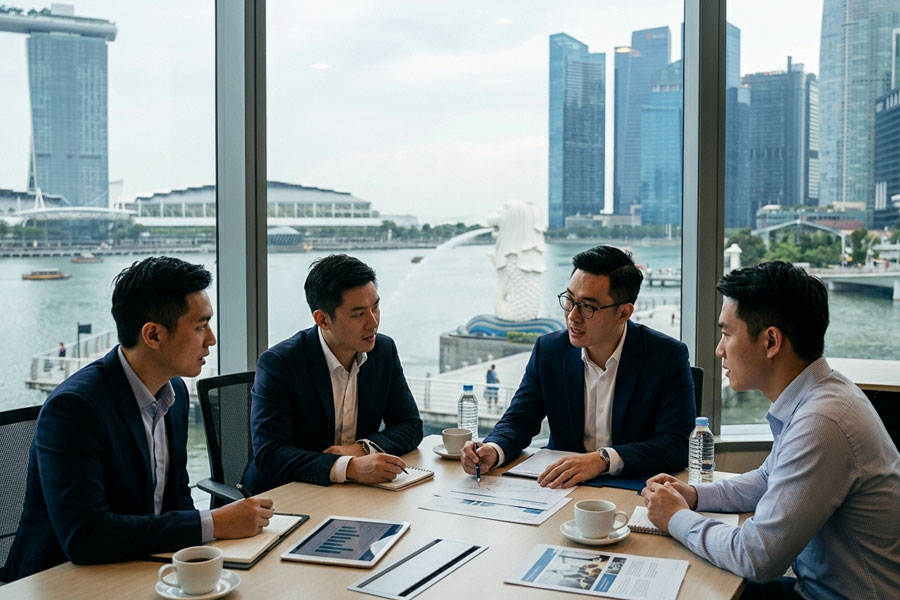
Singapore has firmly established itself as a global wealth management hub, attracting wealthy families from around the world to set up family offices. Singapore’s success is driven by political stability, a transparent legal framework, and attractive tax incentives. In the context of modern wealth management, a family office serves as an entity that manages financial affairs, investments, succession planning, and family governance for ultra-high-net-worth individuals or families. Understanding the different types of family offices in Singapore is essential for families looking to optimize their wealth structure according to their specific needs and the scale of assets under management.
Table of Contents
ToggleDefinition and Role of a Family Office
At its core, a family office is a private organization established to manage family wealth. Its primary functions go beyond investment management — covering tax planning, philanthropy, next-generation education, and lifestyle administration. In Singapore, these entities are often governed under specific tax incentive schemes managed by the Monetary Authority of Singapore (MAS), such as the Section 13O and Section 13U schemes under the Income Tax Act.
Single Family Office (SFO)
A Single Family Office (SFO) is an entity dedicated to serving one family only. It gives the family full control over their investment strategy and operations. Under this model, the family has complete autonomy to determine asset allocation, select investment managers, and set family governance policies.
The main advantage of an SFO is privacy and customization. Since it serves only one family, the structure can be precisely tailored to that family’s unique needs — including complex succession planning and the management of illiquid assets such as property or art collections. However, the main challenge of an SFO is its high operational costs, as the family must bear all staff costs, technology infrastructure, and legal compliance on their own.
Multi-Family Office (MFO)
Unlike an SFO, a Multi-Family Office (MFO) serves multiple families. MFOs often emerge as an evolution of a successful SFO or as a commercial entity established by wealth management professionals. This model offers significant economies of scale.
For families whose wealth is not yet large enough to justify the operational costs of an SFO, an MFO is an ideal solution. It allows families to share infrastructure costs, access world-class investment research, and benefit from professional expertise that would be too costly to hire individually. MFOs also typically provide an extensive network, enabling families to share investment insights and collaborative opportunities.
Embedded Family Office
An Embedded Family Office is a structure where wealth management functions are “embedded” within an existing family business. In this model, the finance or investment department of the family company doubles as the manager of the family’s personal wealth. This structure is commonly found in families whose wealth is heavily concentrated in one main operating business.
Although cost-efficient, this model carries the risk of conflicts of interest between the needs of the operating business and personal wealth goals. Clear governance separation is therefore essential to ensure that family assets remain protected from fluctuations in the operating business.
Strategic Considerations When Choosing a Structure in Singapore
When choosing between an SFO, MFO, or another structure in Singapore, families should consider several key variables. The first is asset scale — generally, an SFO requires a substantial asset threshold to cover its high operational costs. The second is the level of control desired. If a family prioritizes privacy and full control, an SFO is the top choice. However, if the family seeks cost efficiency and access to external expertise, an MFO is often the more practical option.
Singapore offers a supportive ecosystem through clear and well-defined regulations.
The Role of Regulation and Compliance
It is important to note that Singapore has tightened regulations around family offices to ensure the integrity of its financial system. MAS requires SFOs to comply with certain requirements, including a minimum assets under management (AUM) threshold and annual business spending in Singapore. This ensures that family offices make a genuine economic contribution to the country — such as creating jobs for local professionals and using domestic financial services.
The Future of Family Offices in Singapore
Future trends point toward a shift to impact investing and sustainability. Many families in Singapore are now integrating ESG (Environmental, Social, and Governance) criteria into their portfolios. Family offices in Singapore are in a unique position to lead this transition, supported by the country’s rapidly growing green finance ecosystem.
In conclusion, the choice of family office structure in Singapore should be based on a thorough analysis of the family’s needs, asset scale, and long-term goals. Whether choosing an SFO for full control or an MFO for efficiency, Singapore provides unmatched infrastructure for preserving and growing wealth across generations.