LKPM reporting in Indonesia — or Laporan Kegiatan Penanaman Modal (Investment Activity Report) — is a crucial instrument in Indonesia’s investment ecosystem. It serves as a government monitoring mechanism to track the realization of investments made by businesses. Under applicable investment regulations, every company — whether a domestic investment company (PMDN) or a foreign investment company (PMA) — is required to periodically report on the progress of its business activities. This obligation goes beyond a mere administrative requirement; it reflects the private sector’s transparency in supporting measurable national economic growth through accurate investment realization data.
Table of Contents
ToggleLegal Basis and the Urgency of LKPM in Investment
Legally, the LKPM reporting obligation is governed by Law Number 25 of 2007 on Investment. In Indonesian business law, investment is seen as a key driver of development that requires close monitoring to ensure it aligns with national development plans. Through the Ministry of Investment / Investment Coordinating Board (BKPM), the government uses LKPM data to map the distribution of investments, track employment absorption, and measure the contribution of business sectors to Gross Domestic Product (GDP).
Companies that fail to meet this reporting obligation may face administrative sanctions, ranging from written warnings and restrictions on business activities to the revocation of their business licenses. A thorough understanding of the reporting mechanism is therefore an absolute requirement for business sustainability in Indonesia.
Business Classification and Reporting Periods
LKPM reporting obligations differ based on the company’s business scale. Under applicable BKPM regulations, companies are categorized as small, medium, and large enterprises. Medium and large companies are required to submit LKPM reports every three months (quarterly), while small businesses must report every six months (semi-annually).
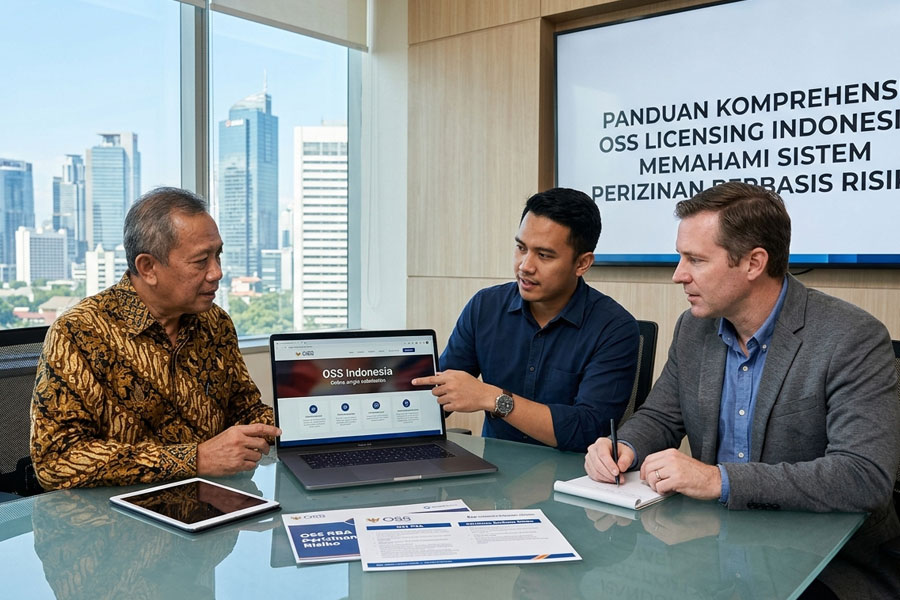
The reporting process is now fully integrated through the Online Single Submission Risk-Based Approach (OSS RBA) system. Migrating data to the OSS RBA system is a prerequisite before a company can submit LKPM reports online.
Challenges and Solutions in LKPM Reporting
Many businesses face technical difficulties when filling out LKPM reports, particularly around classifying the correct KBLI code (Indonesian Standard Business Field Classification) and detailing capital realization. Errors in data entry can cause the report to be rejected by the system or create inconsistencies with the company’s risk profile. To address this, many companies choose to engage professional consultants who are well-versed in investment regulations.
The benefits of using professional services for LKPM reporting include:
- Time Efficiency — Ensuring reports are submitted on time to avoid administrative sanctions.
- Data Accuracy — Consultants help ensure the data entered meets accounting standards and BKPM regulations.
- Strategic Consultation — Providing guidance on other investment obligations that may be relevant to the company’s scale of business.
The Importance of Compliance for Business Sustainability
Complying with LKPM reporting is not just about avoiding sanctions — it is also about the company’s credibility in the eyes of the government and investors. The data reported through LKPM serves as the basis for the government to determine fiscal and non-fiscal incentive policies for specific sectors. Companies with a strong compliance track record tend to find it easier to process follow-up permits or apply for investment facilities.
In a macroeconomic context, the aggregation of LKPM data helps the government project national economic growth. When total investment realization increases, it is expected to boost national output through the investment multiplier effect.
Conclusion
LKPM reporting in Indonesia is a fundamental obligation for every business operating in the country. By using the OSS RBA system and understanding reporting obligations based on business scale, companies can ensure legal compliance while supporting transparency in the national investment climate. For companies that find the process challenging, guidance from experts or professional consultants can be an effective solution to ensure the entire reporting process runs smoothly and accurately.